
Our product rankings are based on analysis of thousands of customer reviews, brand reputation, pricing trends, and popularity data. They represent our honest opinion and are intended as a helpful starting point for your research. Some links on this site are affiliate links — if you buy through them, we may earn a small commission at no extra cost to you. This helps us keep the site free and up to date.
There's no legal test for the word, and plenty of Amazon listings use it loosely. A true professional pizza oven earns the label in three ways: it recovers its heat quickly between pizzas, it copes with long hours of use, and its maker expects it to be used in a business. Our range shows how wide the gap can be, from a 1.8kW countertop model that tops out at 230°C to a 10.3kW conveyor oven.
So before you look at price or looks, check these four things:
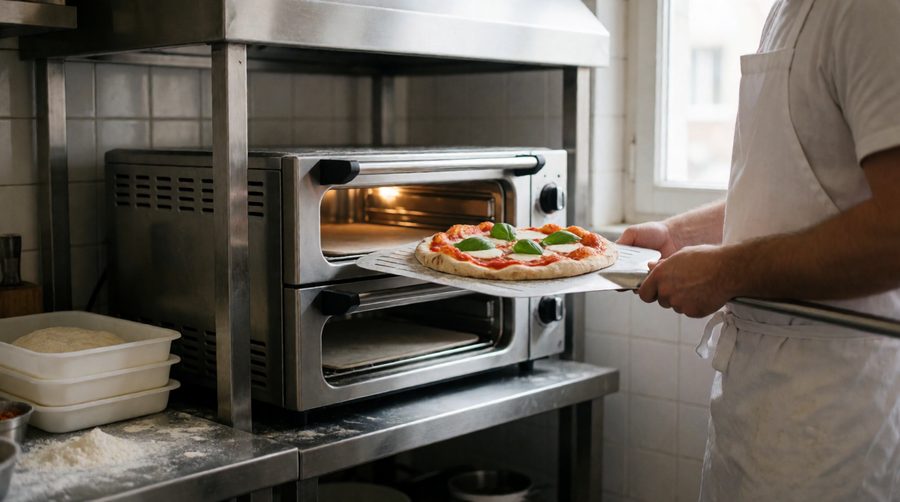
Trade suppliers split commercial pizza ovens by how they heat and how the pizza moves through them. Each type suits a different way of working.
The usual choice for cafés and pubs that want professional results without gas. A single deck pizza oven has one chamber, and a double deck pizza oven (also called twin deck) stacks two in about the same footprint, doubling capacity where bench space is tight. The better deck pizza ovens bake directly on a stone or refractory brick base, which gives a crisper bottom than a metal tray. Most electric pizza ovens in this class reach 350°C.

A gas pizza oven delivers plenty of heat without a big electrical supply, but it brings safety duties too (more on those below). Hostek's GXL6, for example, is a single deck gas pizza oven with capacity for six 14 inch pizzas. Expect to pay more to install one than an electric pizza oven, because it needs an engineer and suitable ventilation.
You place the pizza on a moving belt and it comes out cooked at the far end, so a new member of staff can get the same result as your most experienced cook. That consistency is why high volume delivery shops choose them. Conveyor brands in the UK include Zanolli, Middleby Marshall and XLT, and they're sold in electric and gas versions.
A wood fired pizza oven is a selling point in itself: customers can see the fire and taste the smoke. The cost is more skill, more cleaning and a longer heat-up. Dual fuel models offer a middle ground. Gozney's Dome (Gen 2) and Dome XL (Gen 2) run on wood, charcoal or propane, so you can use gas for a quick start and add wood for flavour. For the home-sized versions, see our multi fuel pizza ovens and free standing wood fired ovens.

These are in-stock models from our range. Amazon listings can be patchy, so where the maker or a UK trade supplier gives a clearer figure we've used theirs (checked November 2026). Vitcas, for instance, lists the Pompeii 140 at 500kg, not the 450kg in some listings.
| Oven | Type | Power | Capacity | Top temp | Weight |
|---|---|---|---|---|---|
| Stalwart DA-CP18S | Electric conveyor | 10.3kW, 3 phase | 20 x 18in an hour | 300°C | 101kg |
| Ital GK059 Stromboli | Electric twin deck, brick base | 3.2kW, hardwired single phase | 4 x 9in | 350°C | 37kg |
| Sirman Stromboli | Electric single deck, stone base | 1.6kW, 13A plug | 2 x 8in | 350°C | 23kg |
| YGHBFRSZ 40L | Electric double layer | 3kW | 16in per layer | 350°C | 34.2kg |
| KM-sI1g79 3000W | Electric double layer | 3kW | 42 x 40cm chamber | 350°C | 27.5kg |
| Hydravex Double Oven | Electric double layer | 2.46kW | 16in | 300°C | 14kg packed |
| Vitcas Pompeii 140 | Wood fired brick dome | Wood | 5-7 small pizzas | Thermometer to 500°C | 500kg |
| Vitcas L | Wood fired brick | Wood | 2-4 small pizzas | Not listed | 525kg |
| Cozze 24in | Outdoor gas, stone base | 13kW | 2 pizzas or 1 x 60cm | 600°C | Not listed |
| Gozney Arc XL | Outdoor gas, stone base | Propane | 1 x 16in | 500°C | 26.5kg |
Three of these commercial pizza ovens need a closer look before you buy. The Crosson double deck oven is listed at 120 volts, the US standard, while the UK runs at around 230V, so ask the seller about the voltage first. The 1800W countertop oven is sold as commercial but stops at 230°C, so we'd treat it as a light-duty option for a kiosk or staff room. And the BTOIASYHF 3200W oven draws a little more than a 13A plug is meant to supply, which brings us to your electrics.
This is where many buyers get caught out. A 13A plug on a UK socket can supply about 3kW, and that sets the ceiling for anything you simply plug in. The table above makes the pattern clear:
Ask an electrician to check your board and your cable run before you order anything over 3kW, and remember the fryer, the fridges and the coffee machine all share that supply.
Size commercial pizza ovens for your peak, not your average. The sum is simple: pizzas per bake, multiplied by the number of bakes in an hour. As an example, a twin deck oven holding four pizzas with a six minute bake gives you ten bakes and 40 pizzas an hour on paper. Allow a margin for stretching the dough, loading, turning and the heat lost each time the door opens, as stone decks need time to recover.
Listed bake times vary hugely. Hydravex's listing quotes 15-20 minutes a pizza for its 2.46kW oven and Crosson's quotes 6-8 minutes, where Gozney claims 60 seconds or less for the Arc XL. Your pizza size matters as well: the Ital GK059's four pizzas are 225mm across, which is about 9 inches, so it suits a café snack menu better than a shop selling 14 inch family pizzas. If small pizzas are all you need, have a look at our 12 inch pizza makers too.
For most menus, 350°C is enough. Pan, American-style and thin crust pizzas bake well at this temperature; they just take several minutes, and a slower bake suits a thicker pizza dough. It won't make true Neapolitan pizza, though. The Italian pizza association AVPN's rules set a dome temperature of about 485°C, a base of 380-430°C and a bake of 60-90 seconds. To get close you'd need a wood fired or high-output gas oven, or a specialist from our Neapolitan electric ovens range, so check its real top temperature first.
An outdoor oven makes sense for a pub garden, a farm shop, a campsite or events, as you avoid most of the cost of indoor extraction and the fire becomes part of the show. The Vitcas Pompeii 140 is the serious option in our range. Vitcas says its largest oven is ideal for food service businesses, pizzerias and festival work, with an internal floor of 800 x 1400mm and room for 5-7 small pizzas at a time. It arrives in 11 sections, and you need a solid base, insulation and more than one person to put it in place. The maker says all its wood fired ovens suit both commercial and domestic use.
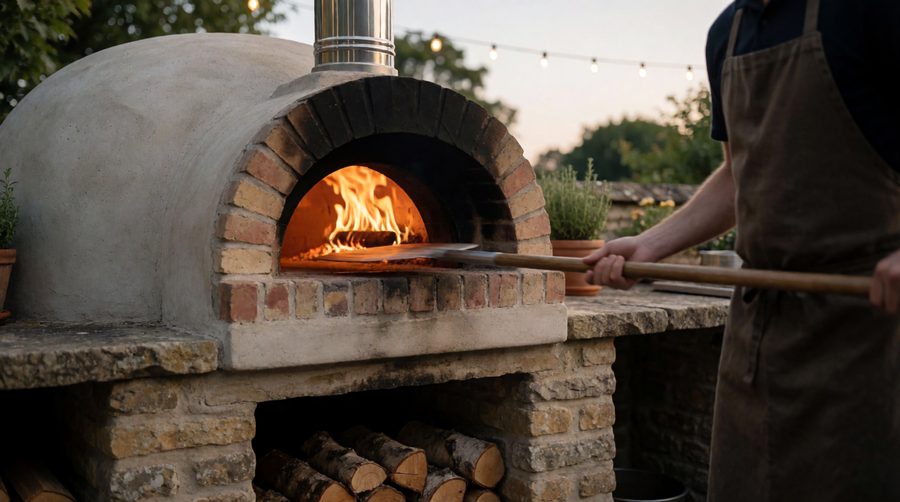
Portable models are tempting for a street food stall, and a high-output one like the Cozze 24 inch (13kW, with room for two pizzas) can work for occasional events. But Cozze itself pitches this oven at family feasts and backyard gatherings, so treat it as a light-use choice rather than one for daily trading, like the smaller mini gas pizza ovens in our range. Protect your setup from the British weather too: damp firewood or charcoal, wet stone and rust all cost you time at the start of a service. Luxury outdoor pizza ovens are often built to tougher standards, though they're still aimed at home use.

The HSE's gas safety in catering guidance is clear on the basics. Gas work must be done by a Gas Safe registered engineer with certificates for that type of equipment. This covers natural gas and LPG, in restaurants and mobile units alike. Annual inspection is treated as a reasonable minimum.
Where a kitchen has mechanical ventilation, the gas supply should be interlocked with it so that a fan failure shuts off the fuel. You'll usually need a canopy above an indoor oven too. HSE also warns that charcoal ovens can't simply be switched off, so they need good ventilation while they cool overnight to stop carbon monoxide building up. Get an engineer's advice early, as extraction can easily cost more than a small oven.
You can use an outdoor pizza oven in a smoke control area, according to gov.uk's rules. The picture changes if the flue goes up through the roof of a building, even a summerhouse. Then you can only burn authorised fuel, unless the appliance is Defra exempt. Ask your council before you build, as it also handles complaints about smoke and smells.
In England, Wales and Northern Ireland you must register as a food business with your local authority at least 28 days before you start trading. That includes trading from a van or temporary premises.
Read this before you put a home model to work. Gozney's warranty terms give home users up to 5 years with registration, but commercial buyers get 1 year with no extension, and they exclude damage from excessive use in a commercial outdoor setting, defined as an average of 15 or more hours a week. Ooni's terms go further: its warranty is for residential or domestic use only, so the ovens in our Ooni range aren't a safe bet for trading. Ask the seller in writing whether the warranty applies to your use, and keep the reply.
Amazon prices change too often for us to print them, but these UK trade list prices (seen in November 2026) give you a useful sense of each level:
Budget for the extras as well: installation, a stand (from around £275 + VAT), an extraction canopy and your first set of oven accessories.
Our range covers what's sold on Amazon, but it's worth knowing the names UK trade suppliers carry when you're comparing commercial pizza ovens. Look at Italforni, Cuppone, Zanolli, Lincat, Fimar, Sirman and Hostek for professional electric and gas deck models, and Marana Forni, Igneus, Inferno and DeliVita Pro for wood or dual fuel. Some suppliers offer installation and leasing, which may suit a large purchase better.
Even the best model needs the right accessories around it. Keep these within reach:
For a café or pub adding pizza to the menu, a 3kW twin deck electric pizza oven on a 13A plug is the simplest start, as it needs no engineer or new power supply. Choose one with a stone base if you can. A shop with heavy evening trade should look at a larger deck or conveyor oven instead.
You can, but check the warranty first, as many are for domestic use only. Daily trading is also much harder on an oven than weekend use, so a home model may wear out sooner than commercial pizza ovens built for the job.
Electric pizza ovens don't produce combustion gases, but they still give off heat, steam and cooking fumes. Employers must provide suitable ventilation, and whether a small oven needs a canopy depends on your premises, so ask a ventilation engineer or your environmental health team.
Yes. The Stalwart DA-CP18S, for example, is also listed for baguettes, toast and sandwiches, which helps you make more use of it outside pizza hours.
It varies by type. The Cozze 24 inch gas oven quotes about 20 minutes. Heavy brick wood fired ovens take much longer, so plan your lighting time around the start of service.


